Poppies Line Art Collection: SVG, PNG, EPS for Designers
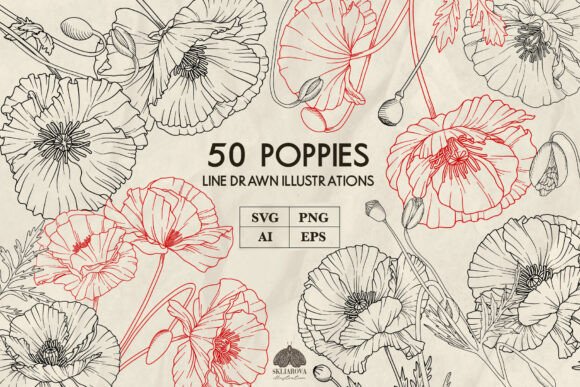
There is a specific challenge in design that often gets overlooked: finding botanical assets that feel genuinely organic rather than sterile or overly digital. When you are building a brand identity or crafting a wedding suite, generic clipart can cheapen the final product. This is where the Poppies Line Art Collection Svg Png Eps steps in. It is not merely a set of images; it is a toolkit of 50 hand-drawn illustrations that bridge the gap between authentic artistic expression and the technical precision required for modern vector workflows.
The visual personality of this collection is rooted in its origin. Because these are hand-drawn without the use of AI, they carry the subtle imperfections and varying line weights that give art a human touch. You will not find the repetitive, mathematically perfect curves that plague machine-generated content here. Instead, you get the organic flow of ink on paper, digitized into a high-end premium font style asset library. This makes the collection particularly appealing for projects that aim to convey warmth, craftsmanship, and timelessness. Whether you are a small business owner looking to create unique packaging or a hobbyist designing a personal journal cover, the Poppies Line Art Collection offers a versatile aesthetic that ranges from delicate and airy to bold and striking.
Technical Versatility: From Vector to Print
One of the most significant advantages of the Poppies Line Art Collection Svg Png Eps is the file versatility. For designers who work with cutting machines like Cricut or Silhouette, the SVG files are essential. They allow for infinite scaling without loss of quality, meaning you can resize a poppy to fit a small wedding favor tag or blow it up for a large-scale backdrop without a single pixel becoming blurry. The AI and EPS vector files further support this, allowing you to edit anchor points and manipulate the artwork in professional software like Adobe Illustrator. This level of control is vital for logo design and brand identity work, where precision matters.
However, the utility extends well beyond vector editing. The inclusion of high-resolution PNG files (4100x4100 px at 300 dpi) with transparent backgrounds solves a massive workflow bottleneck. If you are a content creator or marketer working quickly in Canva, Photoshop, or Procreate, you can simply drag and drop these images onto your canvas. The transparent background means you do not have to waste time masking out white boxes. This is particularly useful for sublimation design and printing on fabrics. Imagine creating a custom throw pillow or a set of tote bags; the high DPI ensures that the line art remains crisp and clean, even on textured materials like cotton or canvas.
Strategic Application in Branding and Marketing
When we look at how the Poppies Line Art Collection influences visual hierarchy and brand perception, we have to talk about the "editorial" quality of line art. In editorial design and packaging design, line art is often used to create negative space and guide the viewer's eye. A single poppy illustration can act as a visual anchor on a menu, a business card, or a website header. Because the style is consistent across all 50 illustrations, you can use multiple assets to build a cohesive visual language. This consistency is the backbone of professional brand identity. It signals to your audience that your brand pays attention to detail.
For those in the wedding industry, this collection is particularly potent. The botanical aesthetic fits perfectly with stationery suites, invitations, and signage. The "line art" style is modern yet classic, fitting well with contemporary typography trends. It pairs beautifully with both serif font styles for a traditional look or a clean sans serif font for something more minimalist. You can even layer these illustrations behind text to create a watermark effect, adding depth to social media graphics without overwhelming the message. This is the kind of creative font asset library element that elevates a design from "homemade" to "professional."
Practical Guidance for Implementation
To get the most out of the Poppies Line Art Collection Svg Png Eps, consider the context of your project. If you are designing for digital platforms, such as web design or email marketing, the PNG files are likely your go-to for quick integration. However, if you are developing packaging design or merchandise, taking the time to utilize the vector files will pay off. You can manipulate the colors to match specific brand hex codes—a feature that is impossible with raster images. This flexibility ensures that the poppy illustrations integrate seamlessly into your existing color palette.
Another practical tip involves font pairing. While these are illustrations, they function similarly to decorative fonts. If you are using a poppy illustration as a divider or an accent, ensure it does not clash with your typography. For example, if you are using a heavy, bold display font, you might want to use a simpler, single-stem poppy to avoid visual clutter. Conversely, if you are working with a delicate script font or handwritten font, a more intricate floral cluster can complement the flow of the text. The goal is balance. You want the illustration to enhance the legibility of your text, not compete with it.
Finally, always test your assets in the final environment. A design that looks good on a screen might behave differently in print. Because these are high-quality design assets, they should hold up well, but checking the line weight on fabric or paper is always a smart move. The Poppies Line Art Collection provides the raw material; your expertise turns it into a cohesive, engaging visual story.